04 / Flagship case study
Machine learning / computer vision
CCTV Violence Anomaly Detection
An offline research pipeline comparing classical and deep-learning models for binary violence classification.
- Type
- Machine learning / computer vision
- Status
- Offline research
- Core stack
- Python / Jupyter Notebook / TensorFlow / Keras / MobileNetV2
- Repository
- Public repository
Project overview
This offline research project compares classical machine-learning and deep-learning approaches for binary violence and non-violence image classification. Its repository retains the frozen data splits, result tables, figures, notebook, and saved model artifacts used in the documented experiment.
01
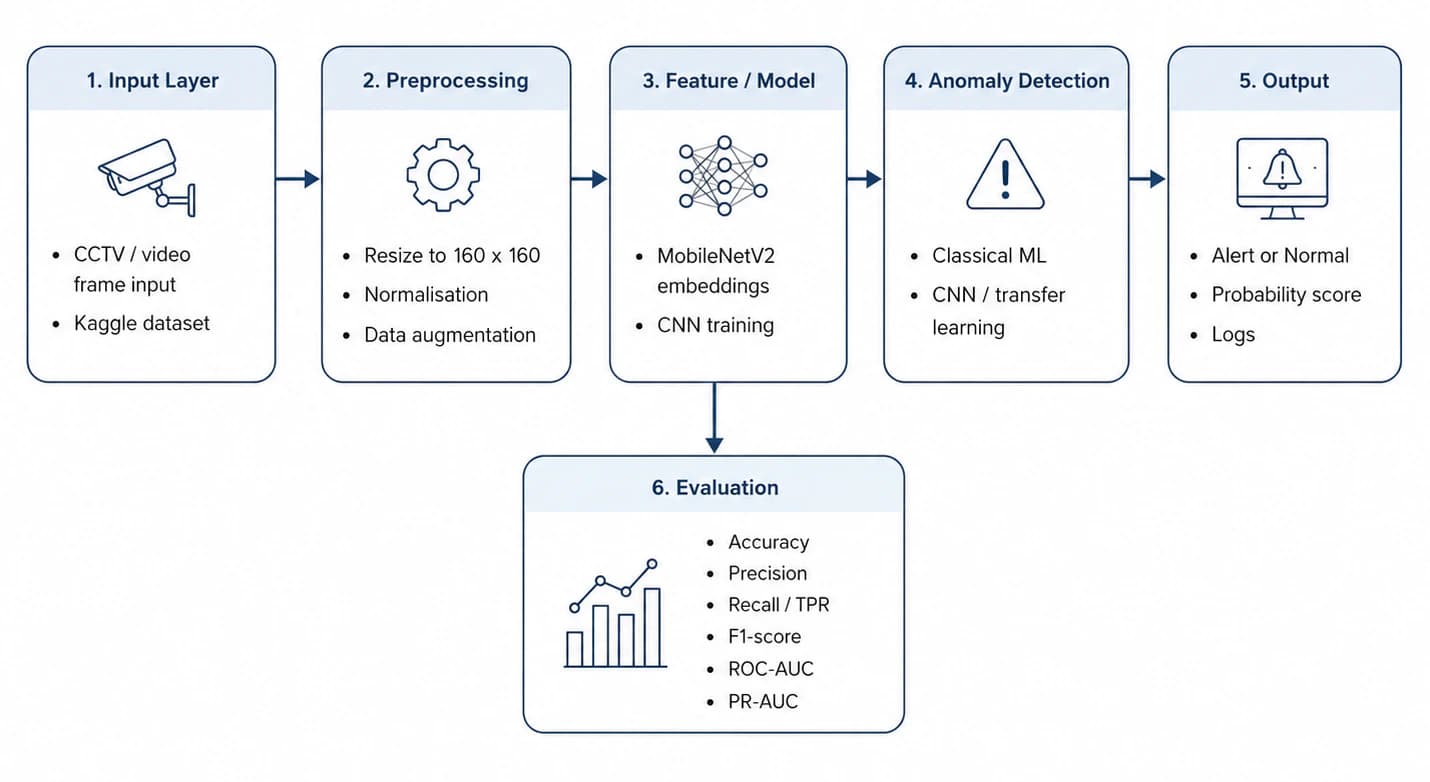
From balanced image subset to offline evaluation
The workflow prepares a fixed image dataset, trains several model families, and compares them on one documented test partition.
Balanced 5,000-image subset: 2,500 images per class
160 × 160 pixel inputs and frozen train, validation, and test partitions
MLP, KNN, Random Forest, Logistic Regression, Linear SVM, and Isolation Forest
Small custom CNN and MobileNetV2 transfer learning
Accuracy, precision, recall, F1, ROC-AUC, and average precision
Comparison tables, curves, confusion matrices, and alert demonstrations
System relationships
- The balanced working subset is split into 3,500 training, 750 validation, and 750 test images.
- Classical and deep-learning model families are trained and compared using the same documented evaluation outputs.
- The result is an offline experiment record, not a deployed surveillance decision system.
02
Eight approaches compared
- Feature-based supervised models
- MLP, KNN, Random Forest, Logistic Regression, and Linear SVM establish classical comparison points.
- Unsupervised baseline
- Isolation Forest provides an anomaly-detection comparison within the same binary experiment.
- Deep-learning baselines
- A small custom CNN and a MobileNetV2 transfer-learning model provide two image-model comparisons.
03
Reported MLP evaluation
The repository reports the MLP as the strongest model by F1 score in this experiment. Each figure below belongs to the balanced working subset and frozen 750-image test split.
94.93%
Accuracy / Multilayer perceptron
- Dataset
- Balanced 5,000-image working subset with 2,500 violence and 2,500 non-violence samples
- Evaluation
- Documented 750-image frozen test split after 3,500/750/750 train/validation/test partitioning
- Limit
- Offline experiment result; it does not establish production CCTV performance or real-time deployment behavior.
99.1%
ROC-AUC / Multilayer perceptron
- Dataset
- Balanced 5,000-image working subset with 2,500 violence and 2,500 non-violence samples
- Evaluation
- Documented 750-image frozen test split after 3,500/750/750 train/validation/test partitioning
- Limit
- Offline experiment result; it does not establish production CCTV performance or real-time deployment behavior.
04
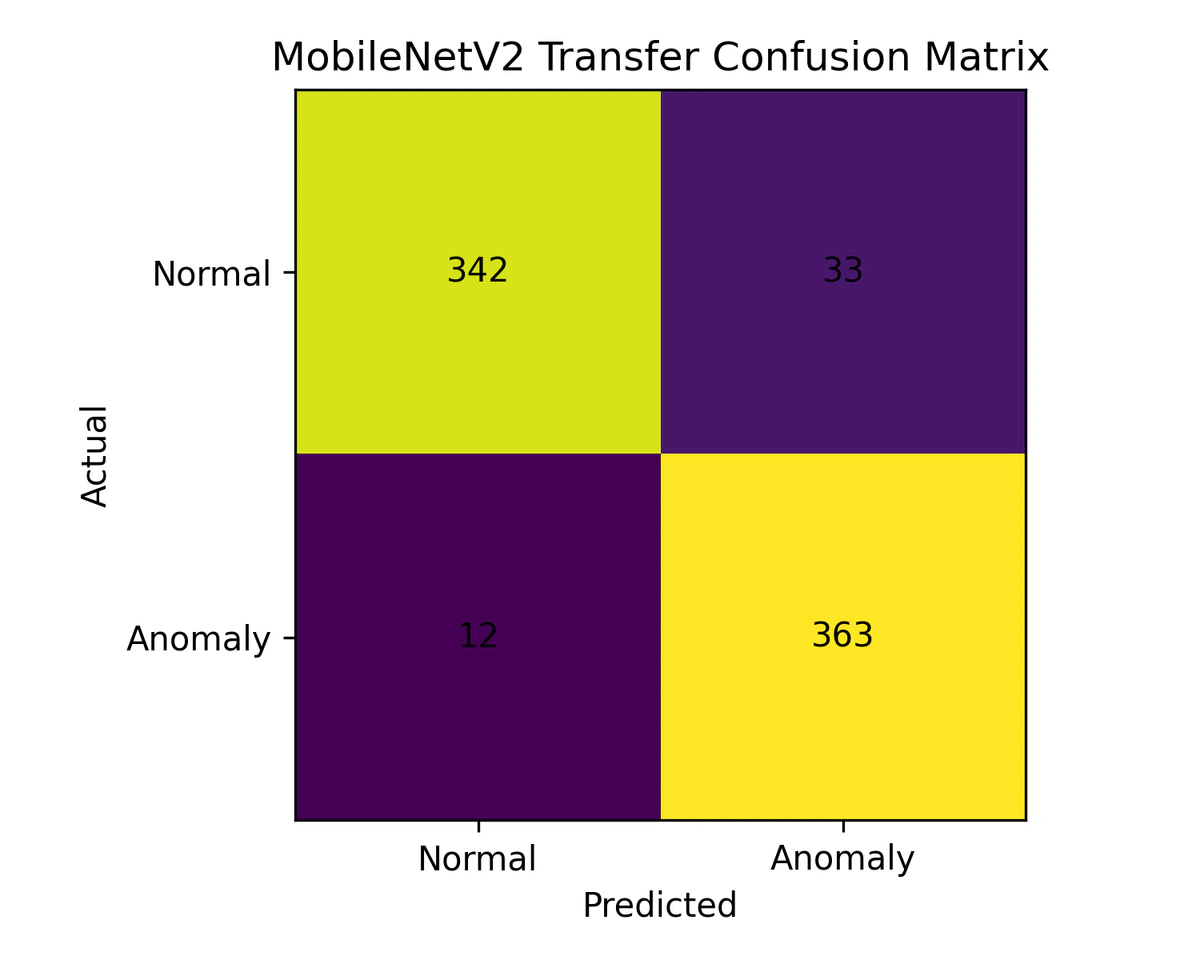
A second model’s error distribution
The MobileNetV2 confusion matrix provides class-level context for a separate transfer-learning result on the same frozen test split.
05
Research limits remain part of the result
- The repository defines this as academic and research work, not a real-world surveillance, policing, or security decision system.
- The models were evaluated on a limited image dataset; real CCTV analysis would require video-level temporal modeling and evaluation across unseen cameras and scene variation.
- Any real deployment would require additional testing, fairness evaluation, privacy review, and human oversight.
- The reported metrics do not establish real-time behavior or production CCTV performance.
06
Technical stack in the repository
- Python
- Jupyter Notebook
- TensorFlow
- Keras
- MobileNetV2
- scikit-learn